

Why Underride Guards Fail and What the Law Requires
Over 500 die yearly in underride crashes. Current regulations leave dangerous gaps — and we hold carriers accountable for them.
What Is an Underride Crash?
When a car strikes the side or rear of a large truck trailer, the height gap between the road and the trailer floor — often 4 feet or more — allows the car to slide directly under the trailer body. The top of the car is sheared off at passenger compartment height. In severe underrides, the entire front of the passenger car disappears beneath the trailer, with the engine, dashboard, and firewall crushing the occupants. Seatbelts and airbags — designed to protect against frontal or lateral impacts with another vehicle’s structure — cannot protect against this type of intrusion.
The Insurance Institute for Highway Safety (IIHS) has documented 500 to 600 deaths per year resulting from underride collisions where a passenger car struck a tractor-trailer from the rear or the side. That translates to roughly two deaths every day from a crash type that is largely preventable with existing technology. Our Kentucky truck accident team handles underride cases involving guard failures and regulatory violations.
Current Federal Law: FMVSS 223 and 224
The two federal standards governing underride protection are:
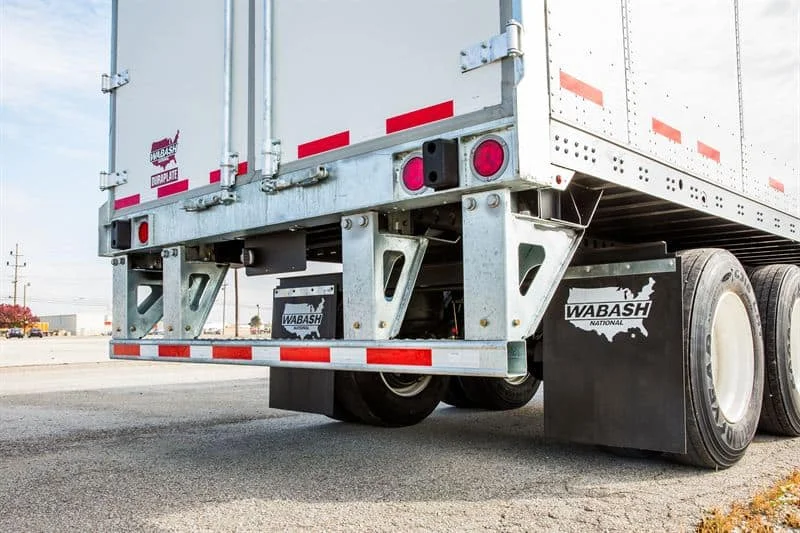
- FMVSS 223 — “Rear impact guards.” An equipment standard that specifies strength and energy absorption requirements for rear underride guards. Guards must be configured low and wide enough to impede a striking passenger vehicle, strong enough to withstand a 30 mph impact, and must have energy-absorbing capability to further protect occupants.
- FMVSS 224 — “Rear impact protection.” A vehicle standard that requires all new trailers and semi-trailers with a gross vehicle weight rating (GVWR) of at least 10,000 pounds to be equipped with a rear impact guard meeting FMVSS 223.
These standards were first issued in 1996. In 2022, following a congressional mandate in the Bipartisan Infrastructure Law, NHTSA upgraded FMVSS 223 and 224 to require rear impact guards to protect occupants of compact and subcompact passenger cars impacting the rear of trailers at 56 km/h (35 mph) in both full-width and 50% overlap configurations. The updated rule became effective January 2023.
The 30% Overlap Gap
NHTSA’s 2022 rule upgrades addressed full-width and 50% overlap crashes but dropped the 30% overlap configuration from its requirements — despite IIHS research showing that 30% overlap crashes are a common and deadly real-world scenario. Safety advocacy groups petitioned NHTSA to reconsider, calling the final rule “inadequate and dangerous” for leaving this configuration unprotected. NHTSA denied the petition in 2024. In crash litigation, a 30% overlap underride into a non-TOUGHGUARD trailer can be powerful evidence that the trailer failed to meet a recognized safety standard even if it technically complied with federal minimums.
What IIHS Crash Testing Has Found
Since 2011, IIHS has conducted crash tests of rear underride guards on semi-trailers. Each test involves a midsize car traveling 35 mph crashing into the back of a parked semitrailer in three configurations: full-width (center impact), 50% overlap, and 30% overlap. To earn the IIHS TOUGHGUARD award, a trailer must prevent underride in all three tests.
When IIHS began testing in 2011, the results were stark: the majority of guards failed in offset impacts. A guard that could survive a full-width center impact would buckle and fold when struck at 50% or 30% overlap, allowing the car to slide under the trailer with fatal consequences. Over the following decade, IIHS’s advocacy and testing program — combined with the 2022 NHTSA rulemaking — pushed trailer manufacturers to develop stronger guard systems. Nine trailer manufacturers have now earned the TOUGHGUARD award for some or all of their trailer models: Great Dane, Hyundai Translead, Kentucky Trailer, Manac, Stoughton, Strick, Utility, Vanguard, and Wabash.
But TOUGHGUARD trailers represent the voluntary high end of the market. Trailers built before the 2023 effective date of the upgraded FMVSS rule remain on the road for decades. Many of those trailers have rear guards that comply with the pre-2023 standard but would fail an offset impact test — meaning they provide little actual protection in the most common real-world underride configurations.
The Side Underride Gap: No Federal Mandate
While rear underride guards have been federally required since 1996, there is no federal requirement for side underride guards on trailers. A passenger car that drifts or is forced into the side of a trailer during a lane-change crash, a T-bone intersection collision, or a merge has virtually no structure between the car’s roof and the trailer’s undercarriage.
IIHS conducted landmark side underride guard testing in 2017. In the test, a midsize sedan struck the center of a 53-foot semitrailer at 35 mph. With only an aerodynamic side skirt on the trailer, the car slid completely under — the impact sheared off part of the roof and wedged the car beneath the trailer. When the same test was run with an AngelWing side guard installed, the guard bent but the car did not go under; occupants would likely have sustained only minor injuries. A 2022 NHTSA side underride analysis estimated that side guards could save approximately 17 lives annually and prevent 69 serious injuries — but determined that the cost-benefit calculation was negative under its central assumptions, declining to mandate side guards at that time.
A June 2024 NHTSA Report to Congress on Side Underride Protection found that the number of side underride fatalities was approximately 80% higher than that reported in fatal crash databases — meaning the problem is significantly larger than official statistics show, because law enforcement often fails to identify and record underride events accurately.
The STOP Underrides Act: Legislation That Keeps Failing to Pass
The STOP Underrides Act — requiring rear, side, and front underride guards on commercial trailers — has been introduced in Congress multiple times: in 2017, 2019, 2021, and again in 2026. In February 2026, Senators Gillibrand and Luján and Representatives Cohen, DeSaulnier, and Ross introduced the Stop Underrides Act 2.0 (H.R. 7354 / S. 3775), which would:
- Require NHTSA to finalize rulemaking mandating side underride guards on commercial trucks
- Restart the DOT’s Advisory Committee on Underride Protection
- Require DOT to publish underride research on a public website
- Instruct NHTSA to review and correct underride misclassifications in its FARS crash database
- Mandate free law enforcement training on identifying and documenting underride crashes
Underride provisions were included in the 2021 Bipartisan Infrastructure Law, but a complete side underride mandate has not yet cleared Congress. Until it does, the gap in federal protection for side underride crashes remains the status quo — and carriers remain free to operate trailers with no side underride guards at all.
The Legislative Gap as a Liability Theory
When a trailer lacks a side underride guard and a person dies in a side underride crash, the absence of a federal mandate does not insulate the carrier or trailer manufacturer from liability. Courts evaluate product liability and negligence claims against the standard of what a reasonably safe vehicle would include. When IIHS crash testing has demonstrated that side guards work, NHTSA has acknowledged the fatality problem, and Congress has repeatedly tried to mandate these guards, a carrier who chose not to equip trailers with available side guard technology has a significant exposure to negligence and failure-to-warn claims.
Liability Theories When Underride Guards Fail
Negligence: Failure to Meet the Applicable Standard of Care
For rear underride crashes after January 2023, a trailer whose guard fails under the current FMVSS 223/224 standard is in direct violation of federal law. For pre-2023 trailers, we evaluate whether the guard met the applicable standard at the time of manufacture and whether the carrier or trailer owner maintained the guard in proper condition. A corroded, bent, or detached rear guard that was never repaired represents direct carrier negligence regardless of manufacture date.
Products Liability: Defective Design or Manufacture
Trailer manufacturers can be held strictly liable when a guard fails in a way that a properly designed guard would not. When IIHS testing shows that TOUGHGUARD-rated guards prevent underride in configurations where a competing product fails, that testing evidence is directly admissible in products liability litigation against the manufacturer of the failing guard.
Negligent Maintenance
Under 49 CFR Part 396, carriers must inspect and maintain all vehicle parts and accessories, including rear impact guards. A carrier that conducts pre-trip and post-trip inspections but ignores a visibly damaged or non-functional rear guard has independent negligence liability regardless of the product’s design.
Frequently Asked Questions
Are rear underride guards required on all large trucks?
If there is no law requiring side underride guards, can I still sue?
What is the IIHS TOUGHGUARD award?
How does underride differ from a typical rear-end or side crash?
What evidence do you gather in an underride crash case?
Start Your Free Case Review
Fill out the form below and our team will reach out to discuss your options.